

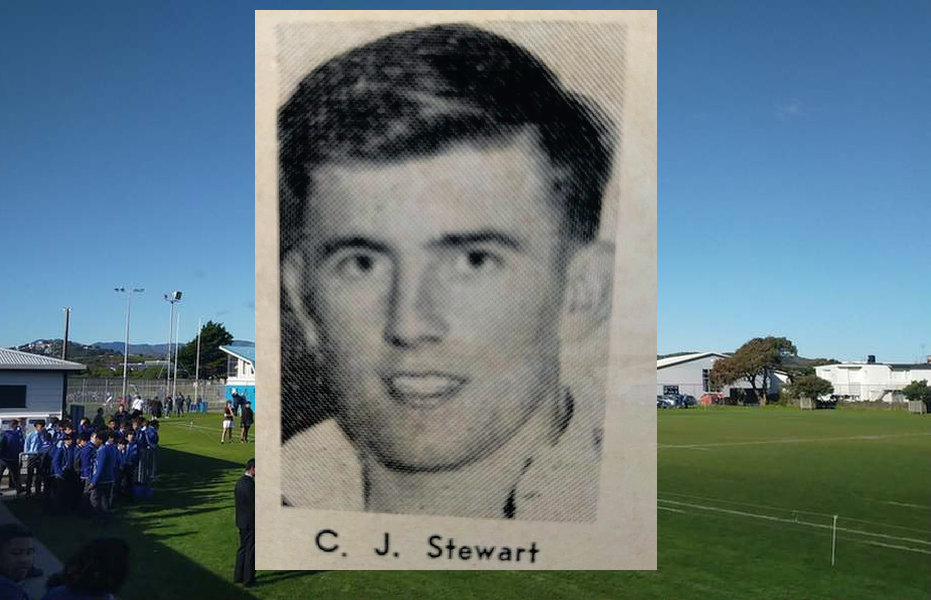


Cam Stewart was Marist’s first-five and playmaker and vice-captain of the side that won or shared the Jubilee Cup in 1960, 1962, 1963 and 1964.
He also played for the Wellington representative team over several seasons and played in many of their big matches at the time. He later played for Manawatu after moving to Palmerston North.
Tragically, Stewart passed away young. He was just 39 when he died in 1976.
Campbell John Stewart was born in Westport on 10 July 1937. He attended Westport Technical College and St Bede’s College in Christchurch.
He was the son of Stan Stewart, also a first-five, who played 51 first-class matches for Golden Bay-Motueka and Buller between 1930-42. His younger brother Bernie was briefly a Buller and Canterbury representative and a Junior All Black in 1972. He scored a try against the touring 1971 British Lions for a combined West Coast Buller side in the 39-6 loss and was later Buller coach 1995-99.
Cam too started his first-class rugby career in Buller, making six appearances for his home union in 1955 out of Westport Old Boys.
Paul Donoghue and Brian Dive on ‘The First 50 years of the Marist rugby club, Wellington,’ wrote:
“As a member of the champion Marist team from 1960-64 Cam Stewart had an uncanny ability to kick for his wings. Partly because of this a Marist wing always headed the try-scoring list in Wellington club rugby at this time.
“Cam Stewart arrived on the Wellington rugby scene as a member of Wellington Marist coach Paul Donoghue’s 1956 senior team.
“In that year notable acquisitions for the 1956 Marist team were the 18-year-old West Coaster Cam Stewart and King Country fullback Bernie Karam. In 1956 both Bernie Karam and Cam Stewart played for the Wellington B team.
Stewart spent much of his rookie season playing at centre, but by 1957 he was mostly playing in the inside backs. The Rugby Weekly noted his occupation then as a ‘clerk’ and his skill for “having an eye for a gap”. He was quick off the mark, and once in space had the skill and vision to set things alight.
He was again noted as a player to watch in early season predictions for 1958. But Marist made a slow start to the season and lost six of their first seven games including a 6-11 defeat to St Pat’s Old Boys in their annual first round ‘Battle of the Irish’ fixture. Stewart and Marist found form in the second half of the season and they went on to win the Hardham Cup.
Marist again battled hard with the leading teams in the first part of 1959. A huge win was beating Onslow 19-14 in the last game of the first round to seal their ‘top six’ spot for the Jubilee Cup.
From there they won all second round matches. Captain Ivan Vodanovich was the team’s outstanding player. Cam Stewart earned himself the nickname ‘General’ on account of the way he managed to dictate tactics.
Momentum was carried on into 1960 and Marist notched its third Jubilee Cup win and first of this era. The principle architects of this success story were coach Frank Ryan, captain Ivan Vodanovich and vice-captain Stewart.

Marist scored 231 points and conceded 96 in 1960, and they scored 47 tries throughout the season.
Petone won the Jubilee Cup in 1961, but Stewart and Marist weren’t far behind. Ivan Vodanovich had retired in the off-season and their forwards were rebuilding.

The following year, 1962, Marist were back on top all season and could have won the Jubilee Cup outright if they had drawn or beaten Onslow on the last afternoon of the season. But Onslow won 14-0 and thus it was shared between the two clubs.

1963 was just as tight, with Marist again leading the way. Heading into the final round, Marist (21 points), Onslow (21) and Athletic (20) were all in with a chance of winning or sharing the Jubilee Cup (two points for a win). Onslow met Wellington in the early game on Athletic Park and Marist and Athletic met. Wellington upset Onslow 9-3, leaving Marist and Athletic in contention. Marist raced to a 11-0 lead and won 28-13, thus winning the Cup outright.
Cam Stewart, Pat O’Donnell, Mick Dennehy, Paul Russo, Tony Redwood, Ian McKinnon and Mick Horan all played in their fourth Jubilee Cup winning team in 1964. Brian Coulter was the halfback in 1964, with Stewart outside him.
Marist made a fast start to 1964, then beat University 16-11 in a key Queen’s Birthday weekend clash. Five weeks later they were almost beaten by Wellington in a big fixture but won 9-8,
The Club Rugby Today in History files summarised what happened in the penultimate match of the 1964 season:
Marist and University go into this title defining clash as joint frontrunners on the table and 10 points clear of the field. In front of a crowd that the Dominion estimates as 12,000 strong, University triumph 16-6 after leading 16-3 at halftime. With one round to play, the Jubilee Cup is surely there’s outright. No. The following week the WRFU pulls five University players out to play for Wellington against Taranaki and they lose to WCOB. Marist wins and the 1964 Jubilee Cup is shared between University and Marist.
The Taranaki match was a Ranfurly Shield challenge, and Taranaki won 3-0.
Stewart returned to Wellington club rugby in 1965, but midway through the season he transferred to Palmerston North. Marist wouldn’t win another Jubilee Cup until their successor club Marist St Pat’s first triumphed in 1978.
For Wellington A, Stewart played 47 matches between 1959-63, scoring eight tries and setting up many more.
Stewart played 11 matches for Manawatu in 1967, representing the Marist club.
In total, Stewart’s first-class record was played 73 games, scoring 14 tries and kicking 5 conversions, 2 penalties and 2 dropped goals for 64 points.
Stewart passed away on 31 March 1976.
MSP’s 1976 annual report described Cam Stewart’s death as an untimely one.
‘Cam was well known throughout New Zealand as a Wellington representative player and a member of the Marist team during their balmy days of 1960-64, when he was one of seven players to play in each of the four winning Jubilee Cup teams.
‘A player whom many considered to be unlucky not to wear the silver fern, Cam Stewart was a New Zealand trialist in 1961 and 1962 and after a year with the Wellington Senior A team in 1956 became a member of that team from 1959-65, when he left for Palmerston North.
Whilst many fine tributes have been paid to Cam by the press and other bodies, it is fitting I believe that the reproduction of a telegram sent to his wife at the time of his death shows the esteem with which Cam Stewart was held by all who knew him:
‘The Almighty selector has chosen to call Cam into his heavenly team and we are honoured and humbled to have been associated with such a wonderful colleague and friend.
‘We pray that God will comfort and bless you all in this time of sorrow.’
Cam’s younger brother and former player and Buller coach Bernie also passed away young.
Amongst Cam’s relatives is 2021 Olympic silver medallist track cyclist Campbell Stewart.

REFERENCES
- Akers, Clive. New Zealand Rugby Register 1870-2015. New Zealand Rugby Museum, 2016.
- Donoghue, Paul and Brian Dive. Marist Brothers Old Boys Rugby Club, the first 50 years. Published 1969.
- Donoghue, Tim. C’mon Red! A Celebration of Marist St Pat’s Rugby. Tim Donoghue Publications, Raetihi, 2020.
- Rugby Weekly publications– various editions mid 1950s-mid 1960s
- Swan, Arthur C.; Jackson, Gordon F. W. (1952). Wellington’s Rugby History 1870 – 1950. Wellington, New Zealand: A. H. & A. W. Reed.
Discover more from ClubRugby.nz
Subscribe to get the latest posts sent to your email.


