

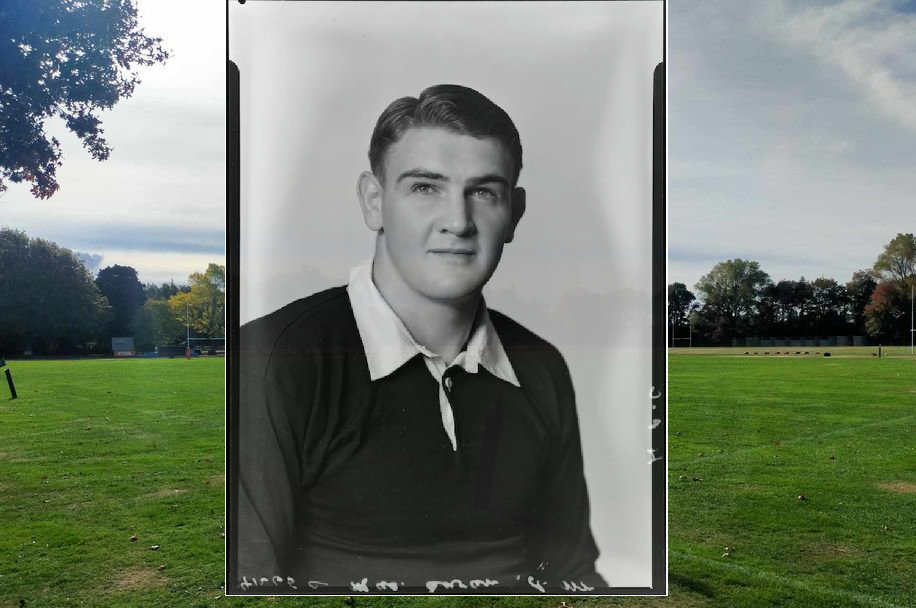


Nev MacEwan was a leading player in Wellington club rugby and for Wellington representative teams throughout his career which spanned 1954-67.
MacEwan was a lock or No. 8 and specialist lineout forward. He played all his rugby for the Athletic Club, the last three seasons as captain and coach, leading his team to Jubilee Cup success in 1965.

MacEwan played 133 matches for the Wellington Senior A side, which is fourth equal on the all-time list and at the time of his retirement the most ever. The others being: Graham Williams (174), Andy Leslie (147), Al Keown (146) and Ken Gray (133).
He was an All Black between 1956 and 1962, playing 52 matches for New Zealand including 20 Tests and several matches as captain whilst on tour in South Africa in 1960.
Ian Nevan MacEwan was born in Auckland on 1 May 1934 and moved to Richmond when he was young.
He attended Nelson College from 1949-52 and was in the First XV in his concluding two years of schooling and winning the Quadrangular Tournament in his final year.
He moved across to Wellington and started Teachers Training College, and he started playing for the club by the same name. After one year he joined the Athletic club whom he would play for over the next 14 years.
MacEwan soon impressed in Senior A rugby for his physicality and work ethic and ball winning ability and made his Wellington debut in a 16-16 draw against Northland in 1954. He played eight matches in his debut year 1954.
He continued to press his claims in 1955, playing his second full season for Athletic and another 11 games for Wellington.
In August 1955 the Evening Post commented “[MacEwan] is one of the finest lock forwards in the country, one who could walk in an All Black pack right now on its merits.”
That year he was named as an All Black reserve in the series against the touring Australians. There were no substitutions in tests until 1968, so that meant he was part of the squad but not stripped to play.
MacEwan commenced his brief teaching career at Rongotai College in 1956, teaching intermediate age boys, with Graham Williams counted amongst his pupils.
That same year the Springboks came to town, and MacEwan played against them twice. First for Wellington in an 8-6 defeat, and second for the All Blacks at No. 8 in the second test in Wellington in an 8-3 defeat and was dropped.
MacEwan would be re-selected the following year and spent the next five seasons in the All Blacks, which included another 19 Tests.
That same season also saw MacEwan win the Ranfurly Shield for the first time, which Wellington won off Canterbury by changing their tactics from expansive rugby to a forwards oriented and kick and chase game and won 8-0.
He was in Wellington’s team that defended it into 1957 but then lost it to Otago, while he moved on from teaching to the first of several other jobs throughout his working career, starting with a brief stint running a petrol station in Ngaio and then working for several years in a shipping company.
There were numerous mentions of MacEwan’s name in local media and Rugby Weekly programmes throughout this time.
One entry on 13 July 1957 after a 16-14 win for Athletic over Pōneke wrote that “MacEwan was great in the lineouts. He was unmatched in his taking of the ball, and timed his delivery to the halfback beautifully drawing all the forwards in. He came down from his jump in a jackknife with his back to the Pōneke forward, and handed the ball back with almost leisurely assurance.”
Here is another headline, from the Rugby Weekly on 6 June 1959, after Athletic and University had fought out a momentous 6-6 draw:

MacEwan formed an effective locking combination at Athletic with fellow Wellington (and later Auckland) representative Dave Harker.
Athletic were always one of the leading sides in the competition but could never get over the line for a championship victory, with the likes of University, Onslow, Petone and Marist all winning the title in this time.
Perhaps the closest MacEwan came in the first part of his career was in 1959, with Petone, Athletic, Wellington and Marist all in the mix right up to the end before Petone won it outright on the last day of the club season.
Athletic slipped to ninth in 1960 and settled for being Hardham Cup champions in 1961, and then struggled down in 11th in 1962.
MacEwan played against the Wallabies in both 1957 and 1958 as he cemented his place in the All Blacks.
Then came 1959 and the British and Irish Lions tour, which MacEwan was to play a big part in. He was in Wellington’s team that went down 6-21 to them and in the All Blacks side in the first three Tests that won the series.

In an interview with Club Rugby in 2015, MacEwan ranked the 1959 British Lions series as the most satisfying experience of his rugby career. He played the first three test matches, but missed the fourth and final fixture in Auckland because of measles.
“The Lions were magnificent tourists. Ronnie Dawson, a hooker, was a superb captain. Roddy Evans and I had great tussles at lock and he became a great friend, finding faith the same year I did. Wingers Peter Jackson and Tony O’Reilly were hilarious. The teams flew to the tests together and Jackson and O’Reilly used to hijack the intercom on the plane and entertain the passengers.”
In 1960 MacEwan made his first big overseas tour, with the All Blacks to South Africa, one in which he captained the side in two matches and one Test. That was the fourth and deciding Test won 8-3 by the Springboks (the same score as his first test lost to them) and the home team won the series 3-1.
He played against France at home in 1961, including in the famous Hurricane Test at Athletic Park that the All Blacks won 5-3 and in home and away tests against Australia in 1962.
MacEwan was sidelined throughout much of 1963 with a knee injury and subsequently missed some big games for Wellington, including their match against England and their winning and losing the Ranfurly Shield in a week. He failed to make the All Blacks. He had in fact played his last Test against Australia in Dunedin on 8 September 1962. In 1963/64 whilst the All Blacks were touring, he had a stint playing for Blackheath club in London.
Back home, Athletic’s fortunes rose in 1963. They were in contention for the Jubilee Cup but lost on the last day of the season to Marist and finished third.
They were eighth in 1964 but then clicked in 1965 and went all the way. Athletic won 15 and lost one of 16 competition games, scoring 268 points and conceding just 99.
The Dominion’s Alex Veysey wrote this of their win:
“…Nev MacEwan’s men won the cup with consistently good rugby, sound and basic whether forward or back. Few scoring opportunities were allowed to go begging, and few were the holes in the defence.
“Last Saturday’s effort [in beating University in the decider] was characteristic of the team’s rugby through the season, honest but never dull.”
The Rugby Weekly wrote: “MacEwan gave himself to this team, which he captained and coached. He has never played better rugby more consistently – and I lump into that statement his best years for New Zealand.”

For Wellington, some of his most memorable rugby was ahead of him.
In 1965 Wellington beat the Springboks and in 1966 Wellington beat the British and Irish Lions. MacEwan was at the forefront of both these wins, locking the scrum with Onslow’s Paul Delaney in both victories. Wellington beat South Africa 23-6 and the following year defeat the Lions 20-6. Two wins that will stand the test of time amongst Wellington’s finest days.
MacEwan’s last season playing for both Athletic and Wellington was 1967. He surpassed his 200th first-class match and his final game for Wellington was Wellington’s 12-12 draw against Hawke’s Bay in Napier in an unsuccessful Ranfurly Shield challenge. Wellington led 12-9 late but a Blair Furlong dropped goal sealed the draw and the home team retained the Shield.
Post-playing MacEwan set up the travel business with Mick Williment later to be called Williment World Travel, then subsequently moved to Palmerston North and became a city councillor for a while.
He spent the last 16 years of his working life up to 2005 as Chaplain of Manawatu Prison.
His brothers Pat and Bill were both first-class rugby players as well, Pat playing 33 matches for Hawke’s Bay and a New Zealand trialist in 1959.
MacEwan passed away on 11 March 2026 in Palmerston North, aged 91.
REFERENCES:
- Akers, Clive. New Zealand Rugby Register 1870-2015. New Zealand Rugby Museum, 2016.
- Chester, R.H & McMillan, N.A.C. The visitors. The History of International Rugby Teams in New Zealand. Moa Publications, Auckland, 1990.
- Club Rugby previous articles. Wellington v South Africa 1956: https://www.clubrugby.co.nz/wellington/story.php?id=1356 /Wellington v South Africa 1965 https://www.clubrugby.co.nz/wellington/story.php?id=1402 / 2015 interview with Nev MacEwan: https://www.clubrugby.co.nz/wellington/story.php?id=1268
- Dominion and Evening Post newspaper – selected clippings
- Knight, Lindsay, Nev MacEwan All Blacks profile https://stats.allblacks.com/all-players/profile/Nev-MacEwan-AB-578
- MacEwan, Neven. When the Crowd Stops Roaring. Wildside Publishing. Northland, 2019.
- Rugby Weekly – various editions 1950s and 1960s.
- Veysey Alex & Fox, Bob. Wellington’s Rugby History 1951-1979, Part 2. Tolan Printing Co. 1979.
- Headline Photo credit: I N MacEwan, 1956 New Zealand All Black rugby union trialist. Crown Studios Ltd :Negatives and prints. Ref: 1/2-191104-F. Alexander Turnbull Library, Wellington, New Zealand. /records/22412505
Discover more from ClubRugby.nz
Subscribe to get the latest posts sent to your email.


