

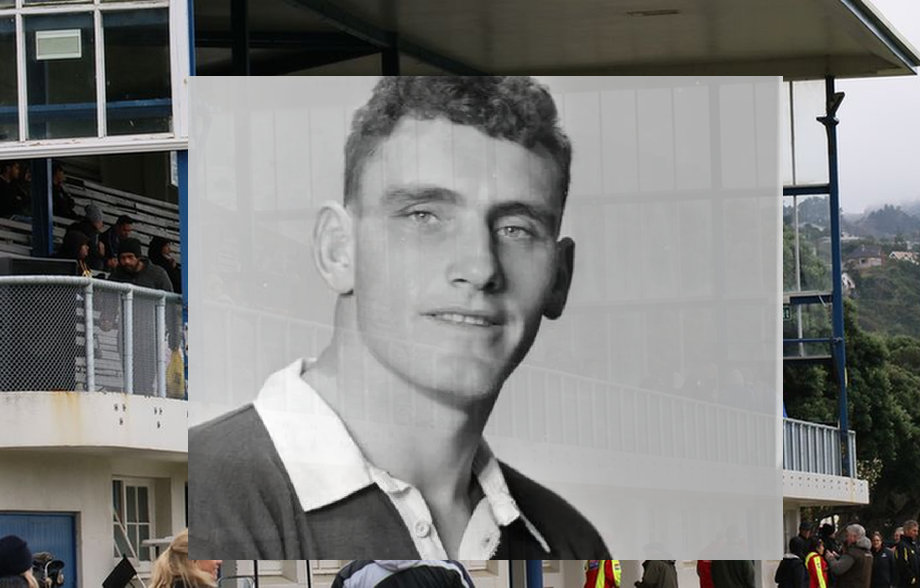


One of the giants of Wellington rugby.
Ken Gray rose to become a leading figure in Petone, Wellington and All Blacks rugby.
“A great forward,” wrote doyen Sir T.P. McLean. “Durable, vigorous, relentless, pursuing, and supremely intelligent.”
Gray has strong ties to both the Paremata-Plimmerton and Petone clubs, having played all his top club rugby at Petone, and since 2015 the two clubs meet in the first round Swindale Shield for the Ken Gray Cup.

All Black 636, Kenneth Francis Gray was born in Porirua on June 24, 1938. He was raised on a 2,200-acre family farm in Pauatahanui.
He attended Plimmerton school and then boarded at Wellington College, as no secondary schools existed in Porirua at the time. Ken’s father (James “Jim” Gray) died when Ken was 13, which required Ken to be very involved in working on the farm.
Gray was a comparatively late developer with a remarkable trajectory for a prop. He was a wing, then half-back at Wellington College where he failed to make the First XV. He played No. 8 and lock for two seasons (1957/1958) with Paremata Rugby Club, was selected for a Wellington XV in 1958, and was selected to reserve for the Wellington provincial team in 1958. In 1959, Gray joined Petone, rapidly earning elevation to full provincial honours, but was predominantly a lock until 1963.
Paremata were a top four side in the Division 2 Harper Lock Shield and the Rugby Weekly labelled them giant killers.
On 21 June 1958, the Rugby Weekly wrote in its second division review:
“What a grand forward Ken Gray, Paremata lock, is turning out to be. His game is going ahead by leaps and bounds. He showed flashes of Kevin Skinner technique by taking the ball from kickoffs to burst through the opposition with unbounded energy and vigour.”
Taking over from Don McInstosh and Bill Dick, Gray was a longtime captain of Petone in the 1960s. From 1959 to 1969 the Villagers won 126 out of 177 matches, including the Jubilee Cup in 1959, 1961, 1967 1968, and 1969. Wellington moved him to prop in 1961, but he continued predominantly as a lock for his club until 1963, the same year he earned selection for the All Blacks.
He made his debut in the opening round for Petone and played mostly at lock and No. 8 throughout 1959. Petone emerged on the final afternoon of the season to win the Jubilee Cup, Gray’s first major title.

He played lock all year in 1960 as Petone finished behind winners Marist.He returned in 1961 as lock, with Bill Dick captaining the side at tighthead prop. Petone beat University (again) 19-17 in the deciding game of 1961.
Petone took the field at the start of 1962 with an unchanged pack, including Dick, McIntosh, tearaway flanker Fred Thompson and Gray – aged 23 and the youngest forward in the team.
However Petone got the early season wobbles, losing to Onslow (5-21) and University (14-21) and were midtable after several weeks.
Then, on Queen’s Birthday Monday, Petone faced top side Marist on Athletic Park in the feature match of the day. Dick was injured and Gray started at tighthead prop and had a blinder in the 12-3 win. The Rugby Weekly opined the following:
“Has Gray ever played a finer club match? He was a prodigious taker of the ball in the line-outs; time and again he was up an winning it for Petone.”
Petone ended up fourth behind joint winners Onslow and Marist with an 8 win/8 loss season record.
Gray played 128 games for Wellington from 1959 to 1969 (captain from 1964-1969). In 1963 he was part of the Wellington team that beat Auckland 8-3 to lift the Ranfurly Shield on Eden Park. Auckland had held the ‘Log ‘0 Wood’ for 25 consecutive defences. In 1965 he was part of the team that beat the Springboks 23-6 and a year later the British & Irish Lions 20-6.
1966 was a vintage year for Wellington rugby and he captained the team that beat the Lions 20-6 and to a season where they lost just one match, away to Canterbury. Gray’s Lions won all four matches on their southern tour for the first time since 1930 and beat (mid-1960s) powerhouses Auckland and Taranaki twice each. The climax of that season was a 20-6 win over new Ranfurly Shield holders Hawke’s Bay. Both Gray and fullback Mick Williment, who played for the University club, passed 100 games for Wellington.

Gray played 24 of a possible 28 Tests between his debut against Ireland on 7 December 1963 until his last international against Wales on 14 June 1969.
Standing 1.90m and weighing 101kg, Gray was a key player in the All Blacks that steamrolled their way to a world record 17 consecutive victories between 1965 and 1969. During his time in the All Blacks, other props came and went – Sir Wilson Whineray, his first captain, Barry Thomas, Jack Hazlett, Alistair Hopkinson, Brian Muller – and Gray swapped sides as needed.
“He was the equal, at least, of (Sir Colin) Meads,” former All Blacks back Grahame Thorne said. “He was the best forward I ever played with.”
Meads in his memoirs said that he “was probably the best prop in the world through the middle and late 1960s. I certainly never played with or against a better. As a line-out jumper, he was matchless, handled the ball well, and was a great runner in close contact. He was a highly intelligent and sensitive man.”
Ken Gray was 25 when he made his Test debut against Ireland on 7 December 1963, but he had only been playing prop for two seasons. In 1961 longtime Wellington prop Ivan Vodanovich retired so Gray switched from lock to loosehead, though he played tighthead in this Test.
Even at 31, Gray would have been a cornerstone in the All Blacks’ campaign to win in South Africa for the first time in 1970. But Gray opted not to tour in protest at the political situation in the republic. He quietly retired on Boxing Day 1969, despite the All Blacks selectors repeatedly trying to change his mind.
He retired having won the Jubilee Cup in 1959, 1961, 1967, 1968 and 1969, and won the inaugural Swindale Shield first round competition trophy in 1969.
Gray retired having been credited with playing exactly 200 first-class games. He scored 33 tries.
He was elected a Hutt County Councillor in 1971. His father preceded him as a member of the Hutt County Council. In 1973 he was elected as an inaugural member of the Porirua City Council, serving until 1977.
He joined the Labour Party and became the vice-chairman of the Kapiti Labour Electorate Committee. Gray served as a board member for New Zealand Rail and chairman of the Government Health Sponsorship Council.
In 1986 he was elected to the Wellington Regional Council in the Porirua ward and served until 1992. He was chair of the council’s operations committee and between 1989 and 1992 he was the council’s deputy chairman.
Gray publicly supported the legalisation of homosexuality in New Zealand, a stance for which he received much criticism from contemporaries. He was responsible for pushing many progressive environmental initiatives and employed at-risk youth on his farm.
In the 1990 Queen’s Birthday Honours, Gray was appointed a Member of the Order of the British Empire, for services to local-body affairs.
In August 1992, Gray was selected as the Labour candidate for the Western Hutt parliamentary electorate in the 1993 election. Tragically, Gray died of a heart attack on 18 November 1992 aged 54. Despite the Western Hutt seat being held by National at the time, historian Lindsay Knight said it was “a seat which Gray almost certainly would have won.”
Labour Party leader and former Prime Minister Sir Mike Moore said “Ken was an outstanding citizen. He was a man of firm principle. He would have made a marvelous MP. Having given more than most people in two lifetimes, he still had so much more to give us.”
Wellington College acknowledges Gray in their annual traditional match with St Patrick’s College, Silverstream with the Ken Gray Memorial Trophy. Petone has run an Academy for developing players since 1995 named after Ken. Paremata-Plimmerton and Petone have played for the Ken Gray Cup annually in the Swindale Shield since 2015.
References
- Akers, Clive. New Zealand Rugby Register 1870-2015. New Zealand Rugby Museum, 2016.
- Club Rugby – several previous stories have been previously written on this website about Ken Gray. Acknowledgement to Adam Julian for writing this one here https://clubrugby.nz/wp/2024/05/15/key-gray-ericka-rere-legacy-project-the-whenua-they-played-on/ and his series in 2025 on the Ken Gray Jersey Legacy Series starting with hist first Test at https://clubrugby.nz/wp/2025/02/26/ken-gray-jersey-series-irish-jersey-1-1963/
- Dominion and Evening Post newspapers. Several clippings 1960s.
- Griffin, Don and Gallagher, Peter. True blue” : the first 100 years of the Petone Rugby Football Club Incorporated, 1885-1985 [Petone, N.Z. : The Club, 1985]
- Rugby Weekly – various editions 1950s-1960s
Gray’s All Blacks portrait. Photo credit: K. F. Gray. Crown Studios Ltd :Negatives and prints. Ref: 1/2-207871-F. Alexander Turnbull Library, Wellington, New Zealand. /records/22910142
Discover more from ClubRugby.nz
Subscribe to get the latest posts sent to your email.


Loved the story about Ken Gray, definitely my favorite All Black prop . During his playing career he got considerably heavier than 101kg,he got up to at least 17 stone .As a young prop for WCOB RFC I was lucky enough to go a front row forwards school run by Ken, something I have never forgotten