

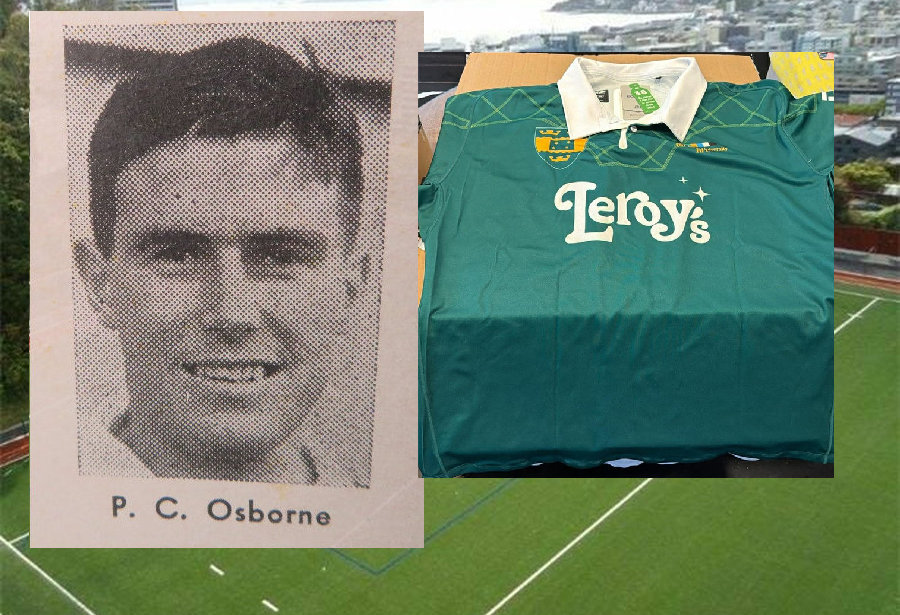


10 June 2026: This coming Saturday Old Boys University will be wearing a one-off alternate jersey against Oriental-Rongotai – an all-green strip paired with white shorts – inspired by the great Jubilee Cup-winning Victoria University Rugby Club teams of the 1950s. It’s a throwback to one of the most successful eras in the club’s history.
The jersey also serves as a tribute to the late Peter “Oz” Osborne, who sadly passed away earlier this year. Oz was a part of the Jubilee Cup winning teams in the 50’s – each jersey has ‘OZ1008’ embroidered – Oz’s Wellington Lions number.
Oz was a fine player (documented below) But at OBU, what he’ll be remembered for most wasn’t what he achieved on the field – it was the person he was off it. Oz was a genuine club man, a great supporter, a mentor to many, and simply a good guy. His passing was felt deeply throughout the club.
The jerseys will be worn for this match only before being auctioned, with details on how to bid to be released through OBU’s social media channels. They are also producing an old-school cotton version of the jersey that supporters and alumni will be able to purchase.
OBU thanks their kit partner and friend of this website Dynasty, as modelled by prop Gareth Ward Allen:

____________________________________________________________
The 1950s were heady times in Wellington club rugby and for University club supporters. Thousands would attend games and follow the Senior A competition closely in a golden period of the Jubilee Cup.
Peter Charles Osborne might have had the best view of all.
He was University’s fullback throughout most of the decade, which coincided with his club winning four Jubilee Cups in 1952, 53 and 54 and again in 1958. Osborne was the only University player to win all four of these titles.
Osborne wasn’t a flashy player; he was known as Mr reliable at the back and few teams ever caught him out of position. But he didn’t need to be. With the calibre of attacking talent around him – particularly in the early years – in All Blacks Ron Jarden and Jim Fitzgerald and others such as speedster wing Brian Battell and the Clark brothers, All Black flanker Bill and his brother and outside back Tony.
Osborne was also in and out of Wellington representative sides for several seasons.
Post retirement, he maintained his strong connection with the University club, including stints in the late 1970s at Club Captain and later as President. He was a WRFU Vice-President between 1989-91 and then WRFU President in 1992 and 1993.
He was on hand as a supporter when Old Boys University won a string of Jubilee Cup wins starting in 2015.
++++++++++++++++++++++++++++++++++++++++++++++++++++++++++++
In 2014, a year before OBU’s first Jubilee Cup win, Club Rugby caught up with Osborne. Some extracts in his own words as below.
I was two years behind Ron Jarden at Hutt Valley High School. I knew the Jarden family well and was mates with his younger brother Lester. Hutt Valley High had a very good First XV for a few years in the mid to late 1940s. In my first year in the team in 1946, aged 15, future NZ cricket captain John Reid was an excellent first five-eighth, future All Black Jim Fitzgerald was the second five-eighth, future Commonwealth Games hurdler Lionel Smith was the centre, Ron Jarden was on one wing, a future Hutt Club player Brian Baxter played on the other wing and I was at fullback. So it was a potent school team.
John Reid probably would’ve been an All Black but in 1946 he got Rheumatic Fever and they said to him you will never play sport again. This was true of rugby, but as we know, he got back into cricket and excelled. Other players to play for this First XV at around the same time included 1950 Commonwealth Games sprinter Don Jowett and future All Black first five-eighth Colin Loader. The headmaster was Norman Millard, whom the former stand at Athletic Park was named after.
I initially joined the Woburn club in the Hutt [now part of Hutt Old Boys Marist] and played two years there. Then one Sunday night in 1950 Ron Jarden rang me and asked who are you playing for next year, why don’t you come and play for University? He explained that they were building up a team and that it would be well worth me coming and seeing how I went. So I did. But I missed most of that first season in 1951 after I broke my wrist after two games.
The team really gelled in 1952, 1953 and 1954 [winning a three-peat of Jubilee Cups]. As well as Ron in the backs, who had made the All Blacks for the first time the previous year, our backline from 1952 had Jim Fitzgerald who was returning from university at Otago and Brian Fitzpatrick, both of whom became All Blacks.

The key to this side was the training we put in and our dedicated coaches, Dick Burke and Ken Uttley, who drilled us hard and created a positive game plan. A mantra that we played by was that we didn’t care how many tries the opposition scored as long as we scored more. Uttley would say that I don’t really care how many tries that the other side score but you have just got to score more, and that is all that mattered. So when we went out on to Athletic Park in this first game in 1952 against Poneke that was our philosophy. No one really knew what to expect – and we absolutely demolished them. Different type of game of course, you could move the ball wide and create space more freely.
There were a number of other top fullbacks at the time. All Black Bob Scott came to Wellington and joined Petone. Scott was a beautifully balanced player. We used to play with leather balls, and once they got heavy and wet they were hard to control. A Wellington businessman and sports supporter named Caesar Cohen used to take us up to Athletic Park at lunchtime and it was at these sessions that Bob showed me how to hold and kick a rugby ball. And I only wish today that he was still around to pass on these skills. Bob’s system was that instead of just throwing the ball up and then booting it you placed it on your foot and as a result you can control what you are doing so much better.
The Pōneke fullback Morrie Hodson and I used to vie for the representative fullback position. This was prior to Mick Williment coming on. In my final year in the team in 1959 I was picked at fullback and Mick was picked on the wing. I was more the defensive type of fullback and Mick was the attacking player, and he was coming into his prime at that stage.
I played about 25 or 30 matches for the Wellington representative A team over a period of several years. I remember my first game for Wellington against Auckland when I got a hairline skull fracture. Of course in those days I went into hospital for three or four days and then after a bit more rest I was back into it. I came right, although people say no actually you didn’t come right! I really enjoyed playing for the New Zealand Universities team as well, that was a fantastic experience.
After retirement I did a little bit of coaching but decided that I wasn’t going to be a good coach so I carried on in administration.
I’m a Life Member of the Centurions RFC and I used to organise all the lunches they have. There’s a lunch coming up prior to the All Blacks Test on Friday 12 September. I was also President of the Wellington Rugby Football Union in 1992 and 1993. I have also been involved as President of Wellington Tennis and of New Zealand Tennis. I have always been a great believer in giving back to what you do.
Club-wise, I was President of University in the 1980s and was later President of OBU for three or four years. I still have a good connection with rugby through Old Boys University. It’s a strong club; we have got a team in the top two competitions which reflects this.
A key difference between our teams and rugby then and now is having forwards constantly in the backline today. How we used to play was our flankers would be standing in behind the backline and acting as sweepers and tidying up dropped ball and the backs would do the running, passing and kicking. It was a lot more decisive.
Similarly, we weren’t spiral-passing, the ball was always presented so that you could run on to it. Speed was not something we were lacking. It terms of a possible game-plan in an imaginary match between my team and the current team it would be get the ball out to Jarden!
I actually reckon our full-strength 1950s team would beat today’s side because we would play as a team. Today’s defence is too often far too porous.
+++++++++++++++++++++++++++++++++++++++++++++++++++++++++
After winning the Jubilee Cup in 1952, 53 and 54, much of University’s side changed with players coming and going from Wellington (and University) and retirements.
University were still competitive in 1955 (won by Onslow), and 1956-57 (both Petone). In 1958 Petone were considered favourites at the start of the season to emulate University and win a three-peat.
University had a completely changed team – with the exception of the ever-reliable Osborne at fullback – and managed to win the title for a fourth time in the decade.
The 1958 side had to fight hard for some of their wins, such as their 11-9 victory over Onslow in the first round that was decided by a missed Onslow conversion, and a 3-0 Queen’s birthday Day 3-0 win over Athletic. They also drew with Onslow 6-6 in their return fixture.

As he wrote above, highly rated Mick Williment was coming through the ranks by the end of the decade and Osborne retired on top.
His first class record was 31 games played and 31 points scored.
This included playing for the Centurions, for New Zealand Universities and playing in two New Zealand trials in 1953.
REFERENCES
- Akers, Clive. New Zealand Rugby Register 1870-2015. New Zealand Rugby Museum, 2016.
- Anderson, John. Victoria University of Wellington Rugby Football Club. The story of the Green and Golds 1902-1987. Tolan Printing Company, Wellington, 1988.
- Club Rugby story with Peter Osborne, published 9 July 2014: https://www.clubrugby.co.nz/wellington/story.php?id=981
- Rugby Weekly publication – various editions 1950s.
- Wellington’s Rugby History 1951-79. By Bob Fox, with assistance by Paul Elenio and Joseph Romanos (Evening Post) and Alex Veysey and Ian Gault (Dominion), with statistics compiled by Gordon Jackson (1951-68) and Alby Butterworth (1969-78). Tolan Printing Company, Wellington, 1979
Discover more from ClubRugby.nz
Subscribe to get the latest posts sent to your email.


