



- By Adam Julian
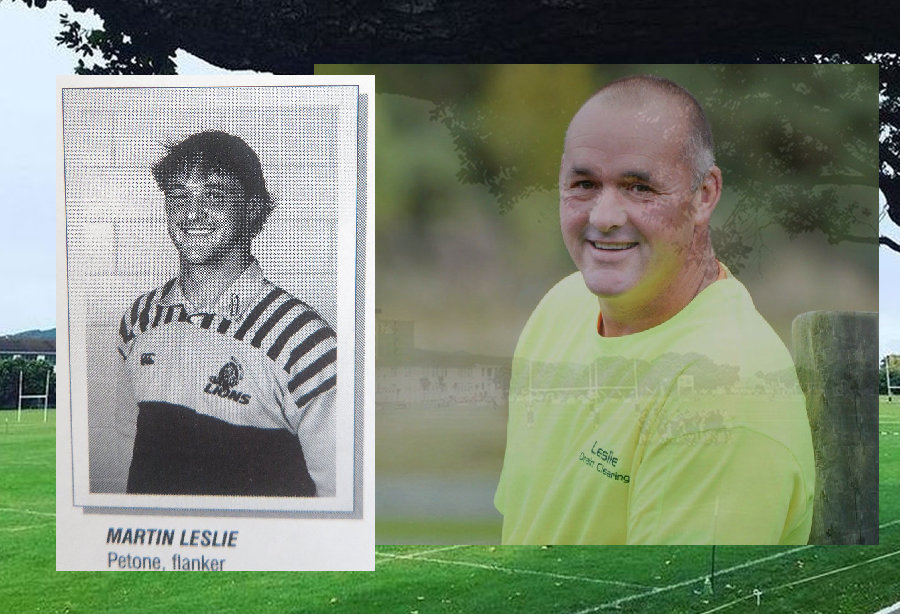
The recent Six Nations broke many scoring records and was regarded as one of the best ever. Noteworthy was Scotland’s 50-40 win over eventual champions France. In 1999, Scotland beat France in a similarly dramatic match in Paris, dominated by Petone legend Martin Leslie.
Petone started the 2026 Swindale Shield with a resounding 48-3 win over Tawa at North Park, in which talismanic openside Braith Ingram ran amok.
The performance brought back memories for the Villagers of another great number seven: three-time Jubilee Cup winner and 37-Test Scottish international Martin Leslie.
Today in Petone, Martin runs Leslie Drain Cleaning on Tennyson Street, his own drain-laying and repair business serving residential, rural, and commercial properties in Wellington, Hutt Valley, Porirua, and Kapiti.
He funded the business with his professional rugby earnings and has run it for two decades, employing several Petone players.

Leslie still takes a passing interest in rugby but is frustrated by what he believes is incessant kicking, an overemphasis on defence, and too much video referee interference in the modern game. An exception was Scotland’s stunning 50-40 win over France in the Six Nations at Murrayfield in Edinburgh on March 7.
That match featured 13 tries, with Scotland scoring over 50 points in the Six Nations for the first time. France also set their highest score in a loss. For context, the All Blacks lost 46-40 to South Africa in 2000, and the record for most points by a losing team in a Test is 54, set by Namibia in their 57–54 defeat to Madagascar in the 2012 Africa Cup.
“It was a heck of a game, wasn’t it?” Leslie said in his usual gruff, understated way.
“That Finn Russell is a terrific player. He attacks the line, spots space, and takes risks. He’s great to watch.
“It’s great to see Scotland doing well. Things are good over there. More Kiwis should give it a try.”
Back in 1999, Martin and his brother John, who was captain, were part of the last Scottish team to win the championship.
In the final round, Scotland beat France 36-23 in Paris – their first win there since 1969. Leslie scored two tries that day.
The next day, Scott Gibbs scored a last-minute try, converted by Neil Jenkins, for Wales in a 32-31 win over England at Wembley in London as Scotland took out the championship for the first time since the famous “Grand Slam” team of 1990.
“Paris was big; even bigger when Wales won,” Leslie laughed.
“I remember they presented us with the trophy at Murrayfield on Monday. Twenty thousand people showed up. We hadn’t slept for three days.
“I don’t really remember my tries – just being in the right place at the right time, I guess.
“What I do remember is that France had won the last two Grand Slams and had thrashed us 51-16 at Murrayfield the year before. They had a great team: Olivier Magne, Thomas Castaignède, Raphaël Ibañez, Fabien Gatlhé. They scored the first try. I thought, here we go.
“But we were a bloody good side. Gregor Townsend, Gordon Bulloch, Kenny Logan, Scott Murray, and Taity – Alan Tait – were all true greats of Scottish rugby.
Centre Tait also scored two tries in a stunning 27-minute burst against France, where Scotland dotted down five times. Tait won a dozen major trophies during a decorated rugby league career, scoring 97 tries in 258 games (171 wins). In addition to his 27-Test Scottish career, he played twice in the British & Irish Lions series victory over South Africa in 1997.
“Taity was pure class and a great guy. He carved them up that day. I never had time to think about what was happening – I just got stuck in, head down, arse up,” Leslie recalled.
“Jim Telfer was our coach. He was a hard man, innovative and fair.”
Telfer, a World Rugby Hall of Fame inductee and former headmaster, played 25 times for Scotland and scored the winning try in the 1969 victory over France.
Martin Leslie is known for doing rather than talking. He left St Patrick’s College, Silverstream, in Year 11 and quickly built a reputation as a tough, hard-working player. In 1988, he helped the Petone Under-19s hand the Silverstream First XV their only loss in 25 games, winning 27-16. Future All Black Simon Mannix played first-five, with Martin’s brother John at second five-eighth.
In 1990, Leslie won his first Jubilee Cup under Māori All Black Frank Walker and All Black Alan Hewson. Petone took the 1992 Jubilee Cup with a 20-1 record, matching that record in a memorable 1993 season when Leslie scored the winning try in the first official Jubilee Cup final, a 27-15 victory over Marist St Pats.

“In one of my first games for Petone, I picked a fight with Richard Watt. That wasn’t a smart idea,” Leslie laughed.
“It was pretty daunting as a teenager playing against legends like Watty. It’s not really like that anymore. The game is much younger now, and clubs are struggling for numbers. Still, the friends you make make it all worthwhile.”

Between 1991 and 1998, Martin played 75 games for Wellington and scored nine tries. Highlights included a 17-9 win over Ranfurly Shield holders Auckland in 1992, the same year he was picked for the New Zealand Colts, who beat Darling Downs 36-0 in Toowoomba, with Leslie scoring a try.
In 1995, he scored three tries in Wellington’s biggest ever win, a 118-17 victory over Italian side Rosario at Athletic Park. Another highlight was a thrilling 29-28 win over Canterbury in 1996, just a year after a humiliating 66-17 defeat in a Ranfurly Shield challenge in Christchurch.
Martin made 21 appearances for the Hurricanes between 1997 and 1998. They were heady days with the Hurricanes making the Super Rugby semifinals for the first time in 1997. That season, Leslie scored tries in the wins against Northern Transvaal (64-32), Free State Cheetahs (59-30), and New South Wales Waratahs (19-3).
“Getting paid to play rugby for the first time was huge. It opened doors that hadn’t been there before and helped you become a better player,” Leslie said.
“At the Hurricanes, we played an attacking style and ran from everywhere. It was great to play and fun to watch. Christian Cullen was a freak – he’d still be great today, but there just isn’t the same space anymore.”
While Martin was making his mark in Wellington, John Leslie was a star midfielder in Otago. He won four senior championships with the University club and played 122 games in blue and gold from 1991 to 2004, scoring 33 tries and earning 82 wins. Leslie also won NPC Division I titles in 1991 and 1998, and scored tries in Otago’s 1993 win over the British & Irish Lions (37-24) and their 1994 win over the Springboks (19-12).
John played 32 games for the Highlanders from 1996 to 1998, helping them reach their first Super Rugby semifinal in 1998. Although an All Blacks call-up seemed likely, he was repeatedly overlooked, so at 28 he signed a professional contract with Fukuoka Sanix Bombs in Japan.
With five months between the end of the New Zealand season and his start in Japan, Leslie was recruited by Scottish coach Jim Telfer to play for Glasgow (then Caledonians, now Warriors) in Scotland.
Martin soon followed, and both brothers were quickly promoted to the Scottish national team, making their Test debuts in a 35-10 loss to World and Tri Nations champions South Africa at Murrayfield in November 1998.
They qualified because their grandfather, Andy Leslie Sr, was born in Linlithgow and migrated to New Zealand. Andy Sr played professional football for Hibernian FC. The centre-forward also won New Zealand’s Chatham Cup twice in 1928 and 1930 for Petone. He was capped six times by the All Whites in the pioneering days of Kiwi football. His son, Martin and John’s father is former Petone, Wellington and All Blacks captain Andy Leslie.
John was appointed Scotland’s captain for the 1999 Five Nations (Italy joined to make it the Six Nations in 2000). The start to his captaincy career could not have been more dramatic. He scored a try after 10 seconds, still a world record, in the 33-20 win against Wales at Murrayfield.
From the kickoff, Leslie picked the pocket of Wales’ Kiwi fullback Shane Howarth to score the tournament’s quickest try after a Duncan Hodge kickoff ruse. He told Stuff’s Tony Smith in 2022.
“It was Jim’s idea …He said, ‘Right, we are going to outsmart the Welsh. ‘We are going to kick it the wrong way.’ The plan was for Hodge to suddenly kick right-to-left instead of left-to-right, which Wales wouldn’t be expecting. It didn’t work all week on training, then on the day, magic.”
The following week, Scotland was much the better side against England but lost 24-21 at Twickenham despite two tries by Alan Tait. John had his neck stood on by English captain Martin Johnson (84 Tests, 67 wins). Seconds before loose forward Tim Rodber rammed his knee into John’s back.
Martin, alongside British and Irish Lions prop Tom Smith, exacted revenge upon Johnson in a lineout. While he “dealt to” Lawrence Dallaglio in a ruck. However, Scotland had to wait until the following year to conquer England. Duncan Hodge scored all 19 points in a memorable six-point Murrayfield win in 2000.
Scotland’s 1999 campaign got back on track with a 30-13 win over Ireland in Edinburgh, highlighted by a brilliant try from Stuart Grimes – one of the best ever scored at Murrayfield.
The demolition of Ireland set the stage for the stunning result in Paris. Although Martin played in Scotland’s first win over South Africa in 33 years at Murrayfield in 2002, April 10, 1999, in Paris was the highlight of Martin and John’s Scottish careers. Two decades later, they returned to Scotland for a reunion. Martin recalled:
“That was a lot of fun. Rugby in Scotland has a great tradition, and the fans were awesome. At that reunion, we raised money for Doddie Weir and his fight with motor neuron disease. He was a champion. That’s what rugby is all about.”
Did you know?
Scotland’s Gregor Townsend became only the fifth player in history to score a try against each of the other countries in a single Five Nations tournament in 1999. He also became the second Scotsman to do so, following on from Johnnie Wallace from the 1925 Grand Slam-winning team. The others to achieve the feat were Carston Catcheside (England, 1924), Patrick Estève (France, 1983) and Phillipe Sella (France, 1986). In the 2025 and 2026 Six Nations, won by France, winger Louis Bielle-Biarrey scored tries in nine consecutive games, including four in a 48-46 win over England in Paris in 2026. Townsend has been involved in 90 of Scotland’s 342 wins all-time, 58 as a coach and 32 as a player, up to April 6, 2026.
With the exception of one year, a New Zealander has played in the Six Nations every season since 1989, when Sean Lineen, a former Counties police officer, became the first “Kilted Kiwi.” Lineen helped Scotland win the Grand Slam in 1990. Another New Zealand fullback, Glenn Metcalfe from Auckland, was part of the 1999 Scottish Five Nations winning team.
John played 23 Test matches for Scotland and scored four tries, with his others coming during Scotland’s 2000 wins at Murrayfield against the USA (53-6) and Ireland (32-10). His final Test was on April 6, 2002, when Scotland defeated Wales 27-22 in Cardiff. That game was also the last international match called by Bill McLaren, who worked for the BBC for fifty years and whom Martin called “a great bloke.” After his playing career, John ran the LeslieRugby business, which supplies rugby products such as balls and jerseys to clubs and schools. He also coached the Northland NPC team and remained involved with Otago University rugby. His son, Jack Lesile, played seven games for Otago.
Martin scored ten tries in international matches. His last Test was a 39-15 win over the USA at the 2003 Rugby World Cup in Brisbane. Leslie was cited for kneeing US player Jason Keyter in the head and received a 12-week ban, which he described as “ridiculously harsh.” In the same tournament, Fijian winger Rupeni Caucaunibuca received only a two-week ban for punching two French players in the head.

Discover more from ClubRugby.nz
Subscribe to get the latest posts sent to your email.


