

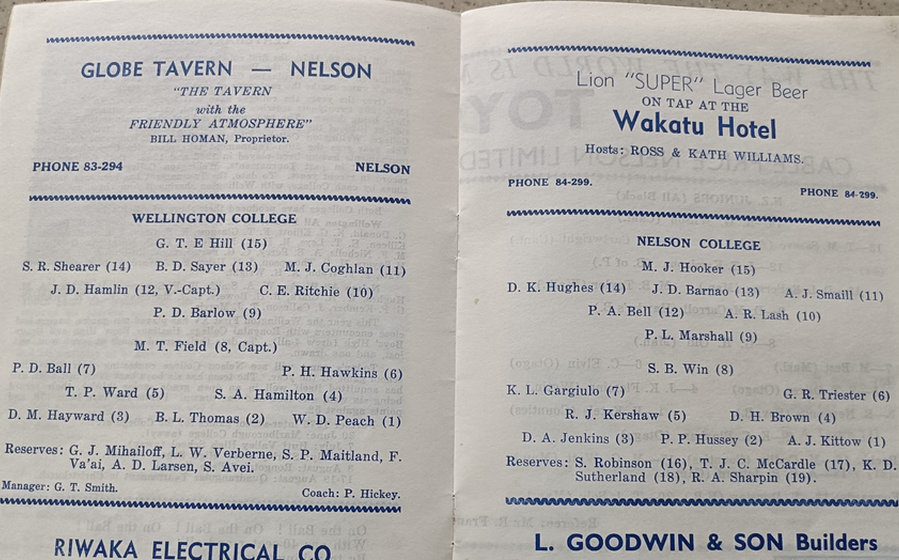
The match-day programme when Wellington College and Nelson College met in 1976.


By Adam Julian
When Wellington College hosts Nelson College in a one-off fixture on Saturday to celebrate the 150th anniversary of the first interprovincial secondary school game of rugby in New Zealand, it will bring together friends, old rivals – and even old rivals who later became friends.
Take the case of Ted Thomas and Paul Bell, who will be among those who pause, reflect, and make the most of the present while also acknowledging the past.
Back on June 16, 1976, Bell was head prefect and First XV second five-eighth at Nelson College, while Thomas was Wellington College hooker for the one-off clash between the schools at Trafalgar Park in Nelson to mark the centenary of the same coveted fixture.
But today Thomas and Bell are old mates. Thomas, a director in financial services software, is President of the Wellington College Old Boys Association and a key figure in promoting the sesquicentennial festivities. These include a golf day and a luncheon featuring Rugby World Cup-winning coach Sir Graham Henry and Wellington College All Blacks Marc Ellis and Dane Coles. And Wellington’s First XV coaches are All Blacks Neemia Tialata (First XV 1999-2000) and Piri Weepu.
Bell is a lawyer who has worked in numerous senior and general management roles across telecommunications, health, banking, energy and the Ministry of Foreign Affairs in New Zealand.
Their personal battle of 50 years ago served as a curtain-raiser to the star-studded Junior All Blacks versus Nelson Bays clash (which the Junior All Blacks won 38-11, sweeping all six games of their New Zealand tour).
Nelson College triumphed 3-0 on a muddy field, thanks to a late second-half penalty kick by Dominic Barnao.
“It was at least 45m out, probably 48 on the angle,” Bell recalled.
“The wind helped,” a groaning Thomas reminded him.
“Barnao was an Italian boarder,” Bell continued. “He could kick the ball a bloody mile. When he scored that goal, we knew we had a good chance of winning. Until then, it was a slog between two evenly matched teams.”
“Our No.8, Warren Preston, was the one who gave away the penalty,” Thomas rued.
“The local ref did us no favours. I distinctly remember Barry Sayer, who became a good premier player for Johnsonville, going over for a try, only for John Hamlin to be called for a forward pass. Bugger me, if that was a forward pass.”
“We drank with the ref afterwards,” interrupted Bell. Ironically, Preston was later successful in wine and food distribution.
“We had a very strong forward pack consisting mainly big hairy borders off farms around New Zealand, a couple of good loose forwards, and a fast back line with a good defensive pattern. We did have a drink with the ref afterwards, questioning why he didn’t call an offside intercept against us when we were close to scoring,” interrupted Bell.
Ironically, Preston was later successful in wine and food distribution.


Ted Thomas (left) and Paul Bell (right).
The Wellingtonian, the annual record of Wellington College, noted on the game: “Wellington had the best of most phases of play but did little good in the loose. It was hard to penetrate the Nelson defence and although much ground was gained through hard driving, the wet, muddy conditions seemed to spoil any chances.”
Bell offered a Nelson perspective, “In those days, we played against grown hard men from second division local clubs. They liked to rough up us ‘schoolboys,’ but we stood up for ourselves and beat them on the outside. Games against other schools were what we really looked forward to and measured our season’s success by.”
“I remember there was a lot of excitement about the occasion, with some newspaper coverage that added gravitas. Our team was mostly boarders, battle-hardened country boys and we knew we had a fierce haka. We were honest and had an enjoyable season. We’re looking at having as many as a dozen back for the reunion.”
In 1976, the match programme cost 30 cents. “This year, it’s free,” Thomas said.
Nelson had 14 wins, two draws, and seven defeats in 1976, later beating Wellington 12-7 in the playoff for third place at the annual Quadrangular, which also featured Christ’s College, who beat Whanganui Collegiate 9-3 in the final. Nelson’s most improved back was Michael Hooker. The most improved forward was Graeme Treister.
Wellington College won 14 out of 25 matches in 1976. Halfback Peter Barlow went on to play for the 1981 and 1986 Wellington NPC winning teams. Loose forward Paul Hawkins played 53 games for Wairarapa Bush, including the 1984 and 1985 seasons as captain.
However, there is also a tragic side to this trip down memory lane. The highlight of Wellington’s 1976 season was their record 41-3 thumping of St Patrick’s Wellington and Thomas still marvels at the stirring pre-match speech by assistant coach Calvin Wright.
Tragically, Wright was the victim of a fatal car crash on December 3, 1976, in Peka Peka (between Waikanae and Te Horo on the Kapiti Coast). While transporting a team of Wellington College athletes to the National Secondary Schools Track and Field Championships, his van skidded off the road, killing Wright along with student Phillip Grattan. Students Michael Waite, Stephen Strain, Jeremy Youmans, Robert Park, and Peter Shaw were all injured in the crash.
“It was a shocking end to the year, and because it was the end of the year, there wasn’t really closure for us for a long time since we’d gone our separate ways,” Thomas said.
“Phillip was a bright, friendly young man who excelled athletically, academically, and socially.
“Calvin wasn’t an officially registered teacher but was appointed to teach physical education because he had huge respect among the boys. He wasn’t much older than us, so he related to us differently than the older staff.
“He coached rugby, athletics, volleyball, and basketball. He was a force of nature, fun, practical, and inspirational. He had a big impact in a short time.”
A memorial plaque for Wright and Grattan is now on display at Wellington College.


Calvin Wright (left) and Phillip Grattan (right).
“That’s pretty special,” Bell observed.
“We sadly lost David Hughes last year. He was super-fast on the field and was runner-up to Gary Henley-Smith, who was the fastest 100m and 200m sprinter in the country. We also lost our 1976 College Dux, Dave Morrison, in his first year of University in Canterbury, and Phillip Smith, our 1975 hooker, in a terrible accident in a trial game in 1978. Part of this whole celebration is about honouring them and many of our mates who have passed.”
Meanwhile, Thomas stayed active in rugby, even crossing paths with 1987 Rugby World Cup winners John Drake and Sean Fitzpatrick in his senior career. In 1991, he was the co-chairman of the Wellington College Old Boys and Victoria University rugby clubs committee that drove the amalgamation of the two, creating Old Boys University, a capital powerhouse ever since.
Bell later played volleyball with All Blacks mental skills guru Gilbert Enoka, who helped the All Blacks win 248 out of 303 Tests between 2000 and 2023. His son Nick was later Nelson’s head prefect. Paul and Nick are the only father-son head prefects in the 170-year history of Nelson College, whose most famous old boy might be Ernest Rutherford.
Bell offered simple advice to the boys celebrating the anniversary this time around.
“Enjoy the occasion. Make friends and take the wonderful opportunities that school and rugby provide. I can’t wait for Nelson to win again.”
E te rangatira, moe mai rā. Haere ki te moenga roa.

Discover more from ClubRugby.nz
Subscribe to get the latest posts sent to your email.


