



A look back at how the season panned out 100 years ago.
A recap of the 1926 representative season below.
As discussed in part 1 of this series looking at the 1926 club and grassroots season, Athletic won the Senior Club Championship with University runners-up, ending the multi-year dominance of Petone and Poneke.
The representative season was a poor one for Wellington teams. In modern terminology could be seen as a ‘rebuilding’ year, with retirements and injuries to key players meaning a core group of new players made their debuts for Wellington. It was a baptism of fire for many with losses to most of their rivals in the big inter-provincial contests including one against Hawke’s Bay that went down in the history books for the wrong reasons.
Wellington would provide three players to the 1926 All Blacks that toured Australia, captain Cliff Porter, Mark Nicholls and Australian born Kenneth ‘Snowy’ Svenson.
The domestic provincial season opened on Wednesday 3 June with two matches of note.
The first was Hawke’s Bay’s opening defence of the Ranfurly Shield for 2026 as they slew Wairarapa 77-14 to sound an ominous warning to future challengers. Maurice Brownlie scored a hat-trick.
The second was in Christchurch where Canterbury edged Wellington 13-12. In a classic ‘game of two halves’, Canterbury dominated early and led 13-0 at halftime, only for roles to reverse and Wellington to come roaring back to trail by a point and only Mark Nicholls’ errant boot late in the game saving the home team.
Wellington players selected in the North Island team for the annual North-South game at Athletic Park on were Kenneth Svenson (Athletic), Mark Nicholls (Petone), Cliff Porter (Athletic) and L. A. ‘Shag’ Thomas (Petone). Wellington’s R. Paton was appointed the referee.
The North side featured eight All Blacks from the 1924/25 tour and they won convincingly 41-9. Reports said that 20,000 spectators watched the South team get ‘raked fore and aft’ in the defeat.
A 23-player All Blacks side was selected to tour Australia in July, featuring three Wellington players, captain Cliff Porter, Mark Nicholls and Kenneth Svenson.
Prior to departure this team played Wellington at Athletic Park on 30 June. Right up to the 1950s, in the age of sea travel, it was common practice for the All Blacks to play warm-up or practice matches against provincial opposition – often Wellington – before they departed by ship on their overseas tours. It went well for Wellington.
A rousing second half comeback gave Wellington their second win in as many seasons against the All Blacks, who had 13 players who had travelled with them on the 1924-25 ‘Invincibles’ tour to call upon. Two Wellington players, Porter and Svenson, lined up for the All Blacks against their local teammates.
Trailing 3-11 at halftime, Wellington opened up the second spell with a penalty and they then crossed for a decisive try. Following a ‘forwards rush’, WCOB centre Herbert Grenfell cut through to score. Wellington’s forwards continued to press and two more penalties put them clear. Wellington captain and forward Jim Moffitt, aged 37 and out of the Oriental club, was Wellington’s Player of the Day.
The players went back to club rugby for the next several matches ahead of their next representative game on Wednesday 21 July against the soon to be departing New Zealand Māori team to Europe.
Wellington won this game 28-14 through five tries, two dropped goals, a goal from a mark and one conversion.
The NZ Māori team included two Wellington players, Dodi Wi Neera (Porirua) and Eruera Love (University).
This Māori team would win 30 of 40 games played on another successful overseas tour by a national side.
Wellington’s next match was against Wairarapa on 11 August. In perfect conditions in Carterton, Wairarapa won 24-17 after leading 14-5.
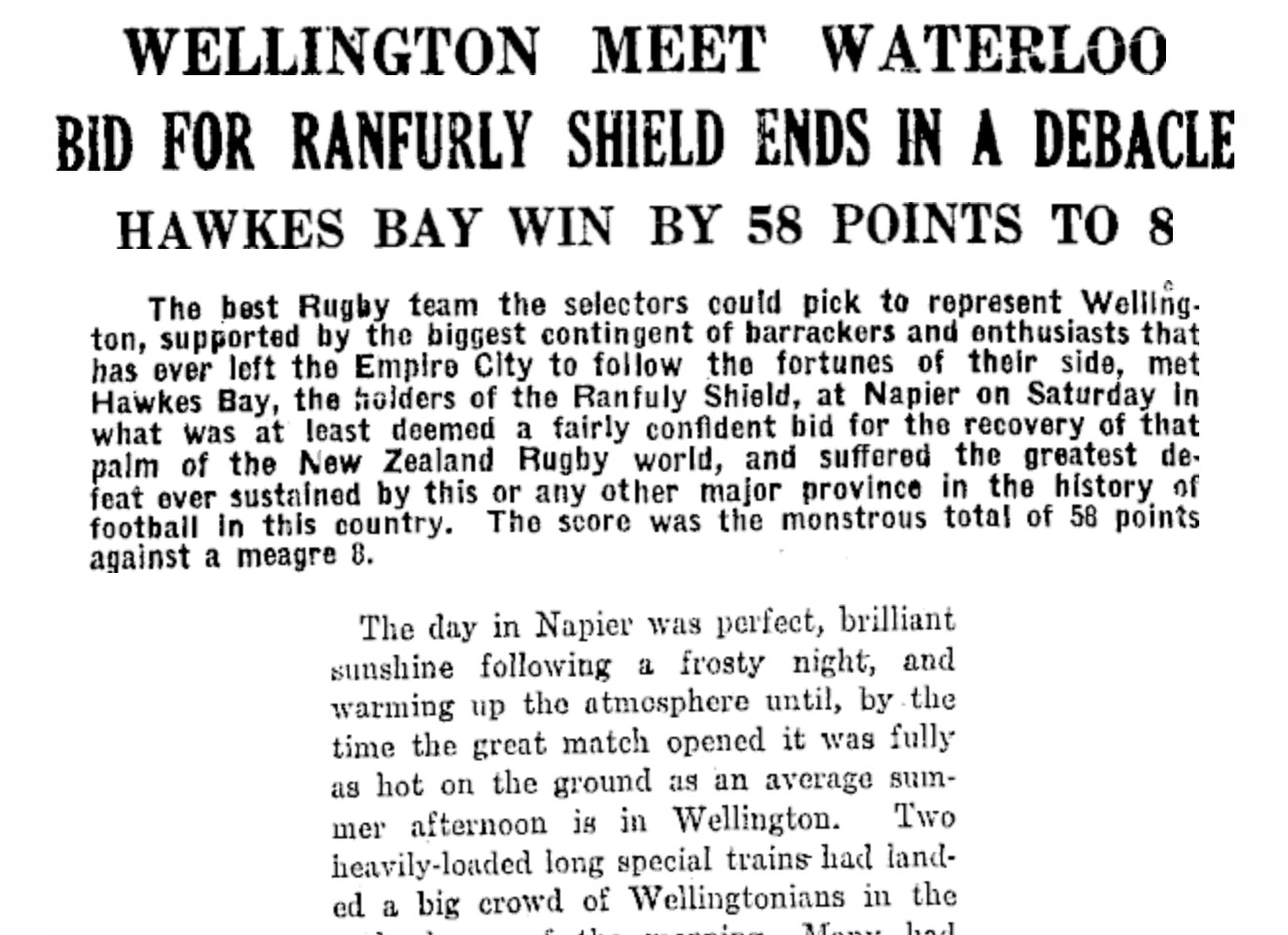
Three days later they challenged Hawke’s Bay in Napier for the Ranfurly Shield.
Anticipation was at fever pitch in both Napier and Wellington for this challenge. Locals queued in their thousands to secure tickets and as many as 1,500 Wellington supporters descended on Napier in two special trains that were put on and some others by motor car.
‘Five-eighths’, in the Dominion before the match wrote: “all roads lead to Napier on Saturday next, when Wellington will make another bid to wrest the Ranfurly Shield from Hawke’s Bay, who raided the Empire City in 1922, and bore away the blue riband of New Zealand Rugby by decisively defeating the holders. Since that date, the wearers of the black and white jerseys have defied all efforts to take the shield from them, and the coveted trophy is still reposing securely under the shadow of Bluff Hill.”
‘Five-eighths’ added that “the Wellington representatives have been training assiduously for this crucial test and will the take the field as fit as fiddles.”
What transpired In Napier on the Saturday was a 58-8 loss to Hawke’s Bay.
Post-match, the Dominion summed it up: “In one of the most brilliant displays of Rugby Football ever given in a first-class match in the Dominion, Hawke’s Bay, at Napier on Saturday, demonstrated its right to be regarded as the Premier Rugby Province of the Dominion by outclassing Wellington in all departments of the game. In stature, physical fitness, speed, rugby brains, but most of all, in their splendid defence, the home team went on brilliantly to win 58 to 8 against the challengers of the Ranfurly Shield.”
Hawke’s Bay opened the scoring in the opening minutes with a massive George Nepia dropped goal. This was followed by wing Grenside flashing in to score the first of his five tries. Grenside then set up Cyril Brownlie for the next try and the floodgates opened. Hawke’s Bay led 24-0 at halftime.
Lindsay Knight, in his book Shield Fever, recounted the journey home for Wellington’s players.
“And as the Wellington team left Napier by train for home they got a constant reminder of the hammering they had suffered. The clickety-click, clickety-click, clickety-click of the train wheels sounded horribly like 58-8, 58-8, 58-8.”

Hawke’s Bay went on to thrash Auckland 41-11 in Napier a week later and then defeat Canterbury 17-15 – in Christchurch in their last challenge of the season.
For Wellington, all they could do is pick themselves up for their next match, hosting Auckland at Athletic Park on 28 August.
The signs weren’t great that they would when several players were declared injured and unable to play. This included star five-eighths Mark Nicholls who was replaced in the XV by University’s R.A.C. Mackenzie. Cliff Porter was also troubled by injury and sidelined.
A cloudy, windy day didn’t help either and reports of the match weren’t glowing either. Wellington was captained by lock Jim Moffitt, playing in his last season for Wellington and out of the Oriental club, after first appearing in 1910 out of the St James club.
Wellington did have the services of its third All Black, Kenneth Svenson, who scored a hat-trick and all of their points but couldn’t prevent a 12-16 loss.
Wellington had held a one-point lead at halftime, but were now turning into the wind. Captain Moffitt also joined the casualty list with a leg complaint and didn’t return for the second spell, meaning that Marist hooker Ned Barry had to lock the scrum (a replacement was brought on).
Auckland overtook them and scored their winning try a few minutes before fulltime.
The Wellington Colts embarked on a three-match tour of the top of the South Island in late August and early September, winning two and losing one.
They lost their first match to Marlborough 9-12, then beat Nelson 18-14 and Golden Bay-Motueka 18-14.
On 11 September the Wellington A team travelled to Palmerston North to take on Manawhenua – a then combination of Manawatu and Horowhenua teams.
The home side led 11-3 at halftime, before Wellington rallied and came back to draw 11-11 during the second half. Horowhenua’s Harry Jacob then scored one and set up another try to put Manawhenua ahead 17-11. Wellington scored a consolation converted try on fulltime to make it 17-16 to Manawhenua.
Wellington then embarked on a three-match tour of the South Island, and all three were lost.
Starting in Dunedin on 18 September, home team Otago won 15-5. The boot of Otago’s Leo ‘Toucher’ Heazlewood proved telling as they went to a 12-0 halftime lead and held on in the second spell. Heazlewood later moved to Wellington and the Athletic club.
On the same day a Wellington XV lost to Taranaki 30-12, as the misery compounded.
Three days later the Wellington team met Southland in Invercargill for another loss, this time 22-16. Reports said that Wellington’s tight forwards were better and the backs were faster but made numerous mistakes. Southland raced to a 16-3 lead and withstood a second half comeback. Southland had Frank Kilby at halfback who the following year moved to Wellington to play for the Wellington Axemen and earn 39 caps for Wellington 1927-35.
Wellington then met Canterbury in Christchurch, and this was another disaster. Canterbury were recently coming off a gallant 15-17 loss to Hawke’s Bay for the Ranfurly Shield at home and resumed where they had left off.
It was closer than the final score showed with a late flurry of scoring blowing it out somewhat. All Black wing Bill Elvy scored a hat-trick for Canterbury, and was playing for Petone and Wellington the following season. Elvy scored five tries for Wellington against Southland in 1929, a union record at that time. Canterbury also had Herb Lilburne kicking goals. Lilburne became an All Black and later transferred to Wellington, captaining the Hutt club to Jubilee Cup titles in 1931 and 1934.
A bright light for Wellington on this South Island tour was Ed Chaney. Chaney played 16 consecutive seasons for Johnsonville in the 1920s and 1930s and today’s Premier Reserve championship trophy is named after him.
There was something to cheer about on the same day with a Wellington XV defeating a Seddon Shield Districts representative team 22-16 at Athletic Park.
Wellington completed a forgettable season at home on 2 October with a 3-11 loss to Hawke’s Bay in their return fixture.
Hawke’s Bay only fielded one forward that had dispatched Wellington in August, and the field was heavy. But the brilliance of midfielder Bert Cooke carried the day for the Magpies.
Stay tuned for a recap of the 1927 season, published here this time next year.
Discover more from ClubRugby.nz
Subscribe to get the latest posts sent to your email.


