

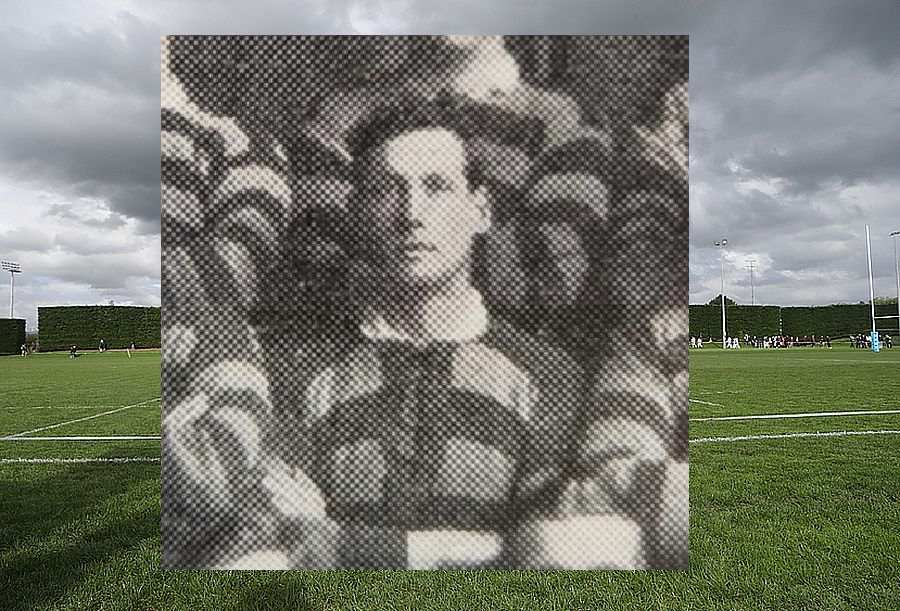


Albin Evenson was a regular Wellington representative player in the decade leading up to the first world war and a key member of the then multi-season champion Athletic Senior team.
Evensen played first-class rugby for Wellington every year between 1906-1914 and played 51 times for his home province, the same number as the great Billy Wallace, whose careers overlapped, placing him amongst the top 10 most capped played in the first era of Wellington rugby up to the start of the 1950s.
All Blacks honours eluded Evensen, but he played for a greater Wellington provincial team in 1907 and played for the North Island side in 1913.
He also excelled in athletics and won several New Zealand Amateur Championship national medals including gold in the 120 yards hurdles in 1910. He was also a Wellington provincial champion in the high jump, 120 yards hurdles and 440 yards hurdle champion.
With that athletics resume, it is little surprise he was a ‘back’ in rugby and often played on the wing or fullback. In 48 matches for the Wellington A side he scored 16 tries.
Albin Charles Evensen was born in Te Awamutu on 11 September 1885. Records don’t provide any details of his early life but the years 1899 and 1900 place him as a student at St Pat’s Town. The St Pat’s Town First XV lost to cross-Basin Reserve rivals Wellington College 0-3 in 1899 but beat them 6-3 in 1900.
Evensen would have been 15 when he left school, so presumably commenced his working life then. He would become an engineer and work for the Wellington Gas Company.
He joined the Athletic club and played in the Junior team before making his Athletic Senior debut in 1905, who were a young team on the rise and also featured a young lineout forward named Arthur ‘Ranji’ Wilson who would go on to be an early Wellington great and an All Black.
Athletic were third in the Senior Championship in 1907 behind emphatic winners Petone and mid-table over the following three seasons, before clicking in 1911 and commencing a run of five winning seasons.
Athletic won the Senior Championship outright in 1911, 1912 and 1913, shared it with the Wellington Axemen in 1914 and won again in 1915. This five-peat of was a record that was equalled by Petone in 1971. Evensen was involved in all these wins.
Of note is that the 1913 success also meant Athletic became the owners of the Swindale Shield, as was custom at the time when teams won a trophy in three successive years. Forgotten for more than half a century the trophy was discovered in a cupboard at Athletic Park and returned to competition in 1969.

For Wellington, Evensen played four matches in 1906 and 1907, and for the Wellington Province team in a one-off game against the All Blacks prior to their Australian tour.
Evensen then played in all 11 matches for the Wellington A team in 1908.
This included playing in the 19-13 win over the touring Anglo-Welsh tourists who were captained by another St Pat’s Town old boy, Pat McEvedy. Evenson played on the wing as part of the Wellington backs contingent that included greats Billy Wallace, Frank Mitchinson and Fred Roberts.
Other matches in 1908 Evensen was involved in included a 3-24 Ranfurly Shield defeat to Auckland, an 11-5 win over Canterbury, a 13-8 win over Taranaki, a 30-0 win over Wairarapa (Evensen two tries) and a 46-5 win over Manawatu (Evensen two tries).
He played five of matches in 1909, including both games on the southern tour that saw Wellington beat Southland 18-5 (Evensen a try) and Otago 13-3.
Evensen played seven games for Wellington in 1910 and was a try-scorer for Wellington in their 17-26 defeat to the All Blacks in a pre-tour game at Athletic Park. He missed Wellington’s mammoth 60-0 win over Southland in early September, but was fullback in both matches as Wellington beat Otago 19-6 and Canterbury 26-9 at home later in the month.

He played six of 10 matches in 1911, including scoring two tries in the 27-9 win over Southland in Invercargill.
Evensen’s inclusion in Wellington teams wasn’t as prolific over the next three seasons, playing four times in 1912 and five each in 1913 and 1914.
He played for the North Island in Christchurch in the annual North-South match in 1913, which the South won 25-0, and also played for Wellington in a 5-6 Ranfurly Shield defeat to Auckland.
In 1914, Evensen was in Wellington’s team that was captained by his Athletic teammate Arthur Wilson that lifted the Ranfurly Shield off Taranaki (who had beaten Auckland). The match on 10 September in Hawera saw Wellington win 12-6 and hold the shield throughout the war years.
A week later he played in Wellington’s final match of the season and his last for Wellington, against Otago at home in a Non-Ranfurly Shield defence. He was listed as a five-eighth alongside Poneke’s Jimmy Tilyard in this game which Wellington won 25-11.
Evensen was 28 when World War One broke out, so he didn’t immediately rush to enlist. Whilst representative rugby was curtailed in 1915, club rugby continued in full in 1915 and the season came down to the final and deciding match between joint leaders Athletic and Petone on 25 September.
In a match befitting a final, Evenson scored and converted the first points to put Athletic up 5-3, before Petone came back to take the lead 6-5. The game then unfolded in dramatic fashion over the last 10 minutes, when, first Petone wing Eddie Ryan was bundled into touch in-goal just as he was about to score to seal his team’s win, and then Athletic snatched victory with a late try to fullback Church. Evensen missed the conversion but Athletic won 8-6 and added the 1915 title to its collection.
This was Evensen’s last act in Wellington rugby. There had been a handful of representative games earlier in the winter, including two against Auckland, but Evensen wasn’t selected for these.
Evensen soon joined the army and he embarked for overseas on 6 May 1916 and was attached to the field artillery in France.
Returning home he resumed his career with the Wellington Gas Company and lived in Karori, before passing away on 18 January 1940, aged 53.
REFERENCES
- Akers, Clive. New Zealand Rugby Register 1870-2015. New Zealand Rugby Museum, 2016.
- Athletic Football Club. Diamond Jubilee 1877-1937 Souvenir Programme.
- Dominion – various reports 1907-1915
- Swan, Arthur C.; Jackson, Gordon F. W. (1952). Wellington’s Rugby History 1870 – 1950. Wellington, New Zealand: A. H. & A. W. Reed.
Discover more from ClubRugby.nz
Subscribe to get the latest posts sent to your email.


