

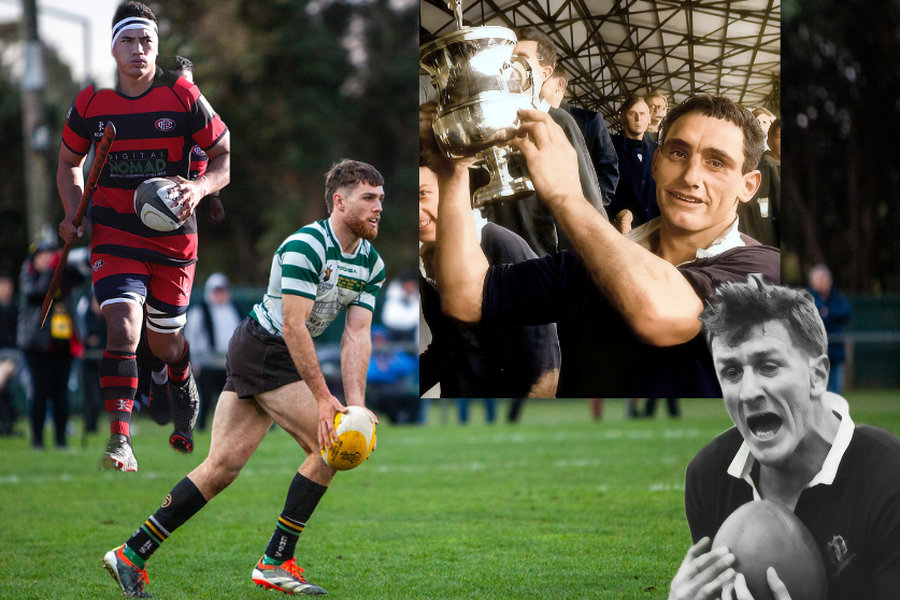


- By Club Rugby contributors
The buzz of watching and following young talent excites fans and academy managers alike.
But some players come on later and mature into great players. Below are some examples of such players, from previous eras to modern times, who came into their own a bit later than many others.
As always, this is not a definitive list, just a general collection – there are probably some glaring omissions!
Feel free to add yours in the comments or accompanying social media post for this article.
For an example of a player that only really took up the game after leaving school and then became an All Black there is Ron Horsley. He joined the Wellington Football Club in the lower grades as a 19-year-old in 1952 having barely played rugby at school at Rongotai College. Horsley adapted fast as a specialist lock. By 1955, media were praising his lineout jumping; by 1958, he was hailed as Wellington’s top lock; and he was the Axemen’s captain.
Horsely earned All Blacks selection for the 1960 tour to Australia and South Africa aged 28. He played 31 All Black matches (including 3 Tests) between 1960 and 1964. He later moved to Manawatu (Kia Toa club), captaining them and adding 37 provincial games there.
Alby Makeham is the first example in this article of the archetypal club and later provincial rugby battler. Makeham won the Jubilee Cup in 1951 with Pōneke aged 22, then honed his game for a further three seasons before making his provincial debut.

Makeham was a Wellington representative between 1954-59, playing 54 matches for his province. He was known for having a fast, sound pass and a strong kicking game and would talk for the full 80 minutes. These attributes came to the fore in several famous matches that he played in, for both club and province.
He earned the nickname Alby “kick it again” Makeham and one such famous match was for Wellington against South Africa in 1956. The touring Springboks won 8-6, but Makeham was part of a stirring performance from Wellington which pushed the tourists all the way. He was also part of a famous 8-0 Ranfurly Shield win over Canterbury in 1956.
The Makeham Shield between Pōneke and Upper Hutt, now the Upper Hutt Rams, has been contested annually in the first round at Premier level since 1989, following his death at aged just 59 in 1988.
Ken Gray’s story was well-documented on this website in a series of articles last year looking at his international jerseys donated to his home club Paremata-Plimmerton and will be profiled later this year in our continuing Pioneers of Rugby in Wellington series.
Gray didn’t make the Wellington College First XV, then played for almost five seasons for Paremata-Plimmerton (second division club) then Petone and some games for Wellington as primarily a lock or No. 8.
He moved to prop for Wellington in 1961 following the retirement of longtime prop Ivan Vodanovich, and Gray adapted brilliantly due to his size (around 1.90m/99-101kg), athleticism, lineout jumping, mobility, and rugby intelligence. Gray was selected for the 1963-64 tour to Britain, Ireland, and France. He made his Test debut on 7 December 1963 against Ireland in Dublin—at age 25. He quickly became a regular, playing 50 All Black matches (including 24 Tests) from 1963-69, often on both sides of the scrum.
Mick Horan is a Wellington Marist clubs rugby legend. Hooker Horan won four Jubilee Cups in five years from 1960-64 with Marist (now one half of Marist St Pat’s) and three of these were as captain.
Horan played for Marist between 1955-65 and, remarkably, was credited with playing over 170 consecutive Senior A [Premier] matches.
Horan’s rise to being one of the leading figures in Wellington rugby wasn’t immediate. He served his apprenticeship in the team for at least five seasons, playing alongside All Blacks prop and later national coach Ivan Vodanovich who was Marist’s captain immediately prior to Horan. He gained a taste of success in 1958 when Marist won the Hardham Cup, and by 1959 the building blocks were being laid for the second half of his playing career.
Marist won the Jubilee Cup in 1960 (o and then in 1962 (shared with Onslow), 1963 (outright) and 1964 (shared with University) and Horan was the team’s leader in the latter three of these.

In an era of high quality hookers in Wellington, Horan only briefly played first-class rugby, but his younger brother and fellow hooker Kevin would later play 99 matches for Wellington.
Mick Horan later turned to coaching, and in 1977 he was co-coach with former Marist and Wellington halfback Brian Coulter of MSP when they won the Swindale Shield for the first time. The following year he was co-coach as MSP won the Jubilee Cup for the first time in 1978, and again in 1979 (brother Kevin Horan was captain of these teams).
In a huge loss to his club and the Wellington rugby community, Mick Horan passed away at just 47 in early 1982.
Andy Leslie embodied the spirit of club rugby and representative rugby, over several seasons at the top of both those levels of the game for Petone and for Wellington.
He started as a back in schoolboy days before switching to loose forward (No. 8) after joining Petone, where he became a mainstay and helped them win multiple Jubilee Cups. He made his Wellington debut in 1967 and went on to play 144 provincial games. What stands out is his incredible durability and consistency: he played a record 96 consecutive games for Wellington across several seasons.
Then, in 1974—at the “advanced” age of 29—he was suddenly called into the All Blacks for the tour of Australia. Not only did he debut (his first game was against South Australia on 1 May 1974), but he was immediately appointed captain without any prior Test experience—a rare honour. He went on to lead the side in every one of his 10 Tests (and 33 of his 34 All Black games overall) from 1974 to 1976, including the tour of South Africa in 1976.
Jeremy Thrush had early success at youth level (part of the 2004 NZ U19 World Championship-winning team and named IRB World U19 Player of the Year), but his path to the top was prolonged.
Thrush debuted for Wellington Lions in 2006, earned his Super Rugby spot with the Hurricanes in 2008, and later made his All Blacks debut in 2013 at age 28 (as a replacement against France). This made him one of the older debutants in the professional era for New Zealand. Thrush’s story highlights grinding through consistent provincial and Super Rugby appearances showing perseverance pays off even after early promise doesn’t immediately translate to the black jersey.

When Jeremy Thrush played his 100th game for the Hurricanes in 2015
Like Thrush, Ross Filipo attended the hallowed halls of Hutt Valley High School and was in the NZSS team in 1997 and was destined for a big career. It took several years for that to transpire, Filipo learning his game at Petone in club rugby and winning the 2000 Jubilee Cup during this time.
Filipo played a season for Marlborough in 2001, but it was another two years that the then 24-year-old broke through with regularity with Wellington. From there he earned a call-up to the Crusaders and in five seasons between 2004-09 won three Super Rugby titles. Filipo played five matches and four tests for the All Blacks in 2008 and was a Ranfurly Shield winner with Wellington in his final year with the Lions.
Filipo became a coach, mentoring Waikato for five seasons, assisting the Chiefs and was the Māori All Blacks coach. He is now in Japan.
For examples of players at a level below Thrush and Filipo, a pair of loose forwards that made the Lions later and blossomed briefly were Mateaki Kafatolu (Petone) and Galu Taufale (Wests Roosters/Pōneke/Johnsonville). Both were similar players in that they gave their all in all teams they played for and retired as widely respected and talismanic figures in Wellington rugby.
In 2017 Kafatolu debuted for his province after more than 100 games for Petone. In 2009, he was the recipient of the Billy Wallace Trophy Best and Fairest award as the most valuable player in Wellington club rugby. He also had stints playing in Japan, Romania and Sri Lanka.
“I thought my time had passed, but I was content with that”, Kafatolu told Club Rugby in 2017 after his Lions call-up. “My job was stable and I have two kids to raise. This has been a surprise bonus,” Kafatolu said.
Kafatolu later had short playing stints in Japan and France.
He also earned the nickname “Mutts” which wasn’t necessarily derived from his Christian name Mateaki. When he made his Premier debut back in 2008, he was instructed by his more established (and senior) forward pack teammates to be like an absolute terrier and a nuisance around the field and the new nickname stuck.
He played his 150th match for Petone in 2021 and is currently Petone’s Rugby Development Officer and bleeds blue.

Galu Taufale made his Wellington Lions debut in 2016, aged 29.
The following year he captained the Lions. His his leadership proved essential in lifting the Lions from the championship in 2017 to runners up in the premiership the previous year. In 2017 Wellington won the championship with an extraordinary 59-45 extra-time victory over Bay of Plenty in the final. Earlier Taufale was skipper in a 61-12 overcoming of Southland
He also played three Tests for Manu Samoa in 2017, and five years later in 2022 in the twilight of his career he was still leading Pōneke out to battle each week in Wellington club rugby.
He was already an experienced player when he joined Pōneke a decade earlier.
Taufale started as a junior in Johnsonville where he grew up and initially returned there as a school leaver, playing a couple of years of Colts rugby and his debut season in 2007 in Johnsonville’s Premiers.
He then moved across to the Wests Roosters and played four years there, before joining Poneke in 2012. He played his 100th match (Premier start) for Pōneke in their annual first round match for the Fred Tilyard Memorial Shield in 2020.
Asked in 2022 what makes a successful captain, Taufale told Club Rugby that ““I think I have learned to try and get the best out of the players, and I have found they listen to me and hopefully they take my advice on board.”

Like Taufale, Nick Grigg attended Newlands College. He left school and racked up 85 matches for Petone in the Swindale Shield/Jubilee Cup between 2011-15.
His ability to beat a defender and slip tackles in the midfield saw him score a lot of tries and set up many others for others.
Unable to break through to the Wellington Lions, Grigg, aged 23 and with a Scottish grandfather, flew to Scotland, where he would eventually play six seasons for the Glasgow Warriors and play international rugby for the Scottish 7s and 15s teams.
He made his debut against Irish side Leinster in March 2016 and whilst there helped Glasgow to reaching a pair of Heineken [Champions] Cup quarter-finals and to the Pro14 final in 2019 against Leinster at home, which the visitors won 18-15. He was their player of the year in 2017
He made his debut for Scotland and was capped nine times for Scotland in the international arena.
He left Glasgow after 95 games for them and headed to Japan for a brief stint with the Red Hurricanes in Osaka, then Carcassonne in France and also American NRL clubs Miami Sharks and Old Glory DC.

Grigg when he played for Scotland at the Wellington 7s tournament in 2016.
Moving home, he started a successful ‘third’ career with Hawke’s Bay.
At the end of 2025 Grigg had played over 40 NPC matches for the Magpies and was still going strong.
Kyle Preston went from working as a roofer to winning the NPC with Wellington in the space of 18 months, then a little over 10 months later he completed his transition from shifting tin with his tradie mates to with the All Blacks in the gym. He made his Test debut against the Springboks in 2025, days before his 26th birthday.
Preston enters 2026 as the incumbent Crusaders halfback set to dine out on their new home ground in Christchurch this year.
Preston wasn’t a fast-track success in the seasons leading up to him leading the Wellington Lions to NPC glory in 2024 and then Crusaders selection in 2025.
The former Tawa College student originally joined the Tawa club and played 31 Premier matches for Tawa in 2018 and 2019, mostly as understudy to Kemara Hauiti-Parapara.
He joined OBU in Covid year, 2020 and was a Wellington Development player and on the fringes of selection for the next three years before making his Lions debut in 2023 and making eight NPC appearances and three as starting halfback.
In 2024 he played another full club season with OBU, winning the Swindale Shield and Jubilee Cup double. Another dozen appearances for the Lions followed then his call-up to the Crusaders last year.

Kyle Preston (directly behind the trophy itself) celebrating Wellington’s NPC win in 2024.
In a handful of other examples elsewhere, there is the case of Frank Bunce who was a provincial battler throughout much of his career before becoming first-choice All Blacks centre in the 1990s.
Bunce was in and out of the Auckland team in the 1980s, but a turning point came in 1991 when he moved to North Harbour and then he was selected for Manu Samoa and played in the 1991 RWC.
Bunce was then selected for the All Blacks in 1992 aged 30 and played 55 Tests up to his retirement in 1997 as the second oldest All Black at the time. He continued to play for North Harbour and the Chiefs until his retirement in 1999 in his late 30s.
In 1995, the big hill between Whitby and Waitangirua was named Mt Bunce, because climbing it was doing the hard yards after the player himself.

Innokenty Zykov (Russia) started rugby at 29 or 30 in 2011 after a wrestling career (world tournament winner). He played club rugby in Russia before international selection, earning 21 caps starting at age 30.
Cadeyrn Neville (Australia) played years of club and state rugby in Australia (Queensland Reds reserves, ACT Brumbies pathways) without consistent top-level play, even moving to Japan for opportunities. He debuted for the Wallabies at 33 in 2022 against England, the oldest Australian debutant this century.
Discover more from ClubRugby.nz
Subscribe to get the latest posts sent to your email.


